Showing posts with label accommodations. Show all posts

Monday, November 12, 2018

Make your Trip Historic

The Grove Park Inn in Asheville, N.C. 

            If you’re ready to venture away from the predictability of chain hotels, curb your impulse to book a room on Expedia and click instead on the Historic Hotels of America website.  It’s a tempting selection of over 300 unique accommodations in 46 states, the District of Columbia, the U.S. Virgin Islands and Puerto Rico that have been admitted to this official program of the National Trust for Historic Preservation.  To become a member, the properties have to be faithfully authentic, possess a sense of place, have architectural integrity and be at least 50 years old.  Additionally, they are all designated by the U.S. Secretary of the Interior as a National Historic Landmark or recognized as having historic significance by the National Register of Historic Places.  Those who appreciate architectural detail and craftsmanship will especially enjoy these locations and the care that has gone into maintaining them.                  
Bechtler Museum 
            When my husband and I stayed at The Dunhill Hotel in Charlotte, we had the best seats in the house for an epic bike race that sped through this prime location in the cultural district.   In 2017 the Dunhill was named Best Small Inn by Historic Hotels for its architecture inspired by Italian craftsmen.  We  appreciated being able to walk to museums, especially the jewel-box sized Bechtler Museum of Modern Art and the nearby restaurants and nightlife. 
            Exit the interstate onto a private launch!   The Greyfield Inn on Cumberland Island can only be reached by boat from St. Marys, Georgia. Guests disembark into an unmanicured forested island where wild horses share the rough paths leading to the beach, ruins of mansions and primitive campgrounds.  With only 16 rooms, the all-inclusive gourmet dinners are friendly affairs where you can share tales of island adventures like visiting the tiny rustic chapel where John Kennedy Jr. and Caroline Bessette were married. 
            At the Martha Washington Inn and Spa in Abingdon, Virginia my two sisters and I spread out in our huge 3rd floor room.  General Robert Preston built the hotel in 1832 for his wife and nine children after his successes in the War of 1812.  Much of the original architecture has been meticulously preserved including the 9-foot tall Dutch baroque grandfather clock in the lobby which was brought from  England by one of the Preston daughters.  The hotel is close to the (almost all downhill) Virginia Creeper Trail which draws thousands of bicyclists.  While luxuriating in the cascading pools we spied a bride escaping her photo shoot to hide in the bushes and smoke a cigarette.  She invited us to crash her wedding which featured the macabre theme of Chicago Gangsters complete with plastic Tommy-gun toting groomsmen. 
            History surrounds you at these hotels.  At the Jekyll Island Club in Georgia you can sit in the room where the groundwork for the Federal Reserve was written, or where the president of AT&T placed the first intercontinental telephone call.  You can actually stay in one of the grand summer cottages of the rich industrialists.  Looking out my window I easily imagined myself as one of the country’s elite industrialist wives like Alma Rockefeller who vacationed here in the 1880’s.  She disembarked from her namesake yacht at the dock right outside followed by a parade of servants toting dozens of steamer trunks containing the ten changes of clothes required daily of Victorian women. It was like being in two centuries at once.
            Elsewhere on Georgia’s Golden Isle is the sprawling King and Prince Hotel where beach-side dances were held in 1935 before the hotel housed military in World War II.  Today its Mediterranean architecture and a variety of room styles welcomes guests to the homey community of St. Simons Island.

Grove Park Inn lobby
            After Edwin Wiley Grove became a millionaire by selling his malaria-fighting Tasteless Chill Tonic (it sold more bottles than Coca Cola in the 1890’s) he constructed Asheville’s Grove Park Inn.  Massive stone boulders were excavated and fitted together like puzzle pieces by Italian stone masons and local craftsmen.  The grand hall lobby includes the much-photographed 14-foot wide fireplaces.  Alongside the chimney shafts, surrounded by boulders weighing up to 5 tons, are the original Otis elevators.  Their unique design has been featured in Ripley’s Believe it or Not.  When the inn opened in 1913, Secretary of State William Jennings Bryan proclaimed that the Grove Park Inn was “built for the ages.”  How true.  It has remained one of the Southeast’s premier destinations.
            Charleston has its own Historic Hotels:  the Wentworth Mansion and the Francis Marion.  These are iconic places that represent our city’s history and the passion our citizenry has from preservation.  Together, these hotels and their partner The National Trust for Historic Preservation inspire people to save places where history happened, connect Americans to diverse pasts and are a leading voice in preserving our nation’s culture. 
 

If you Go:


Monday, July 25, 2016

To Sleep in a Tree


Paddle down the Edisto River to a secluded tree house in the forest.  It's secluded, playful, unique and set up for a close-by adventure.  Read about it here:  Gonomad


Tuesday, October 13, 2015

Jacksonville Beach: What Has Endured


             Elizabeth Stark came to what she called the “perfect paradise” of Mayport, Florida in 1914.  There were too many gray-haired people in the rest of the state to suit her she quipped.  Ambitious and savvy, she and her husband bought all the land they could:   hundreds of coastal acres.  It was christened Wonderwood.  They built a 1,000 foot fishing pier and several houses.  They raised polo horses and grew figs. She anointed herself the Queen of a cast of eccentric characters that included mobsters, movie stars, industrialists and treasure hunters that took advantage of the new rail lines  It endures today as a picturesque car ferry.  Wonderwood became a symbol of the developing South and Elizabeth its defender.  When World War I broke out, she famously protected her bulwark by assembling a stalwart troop of armed Girl Scouts on horseback that patrolled the beaches.  “Although we never had any spies arrested, we kept a lot of them on the move,” she boasted in her memoir. 
making their way South.  Previously the only way to easily reach Mayport was by shooting a gun in the air to call a rowboat ferry which began in 1874 to carry farmers, merchants and travelers across the St. John’s River.
            But time in her paradise was curtailed by the government. In 1940 the Marines evicted the Starks, raised Wonderwood and built an officer’s club.  President Roosevelt insisted that Mayport become a military base. An officer “followed me out on the street and told me to leave and never put my foot on the property again,” she wrote.  Unbowed, she found “a suitable shack” on the beach to live in which reminded her of the Girl Scout “hun hunters”. She claimed she was happy. 
            Meanwhile, along the nearby coast, hotels were springing up to meet the growing demand:  The Continental, The Atlantic Beach Hotel, Perking House and the Palmetto Lodge.  The Spanish-Mediterranean designed Casa Marina was built in 1924. Every one of those hotels except the Casa Marina burned to the ground, victims of the lethal combination of heart pine floors, lanterns and candles.  It was fire proof, constructed of stucco, concrete and tile.  It had the beach’s first sprinkler system.  So it endured.  Its tenacity is reminiscent of Elizabeth Stark’s.  She could have been its muse.
        
    Like Wonderwood, the Casa Marina and its ocean-side dancing are a symbol of the glamour of the golden age.  In the 1920’s the hotel hosted the Duke and Duchess of Windsor, the Rockefellers and President Truman.  Jean Harlow and Al Capone were rumored to have been guests.  Machine Gun Kelly came to dine.  Spenser Tracy and Katherine Hepburn may have rendezvoused there. Weekly rates were $25 including three meals per day. Along the 40 miles of beach, women swam in shoes and rented woolen bathing suits that weighed up to 25 pounds when wet.  Just up the beach a Red Cross life-saving station was established in 1915.  It is now the oldest continuing operating
volunteer corps in the country. But then the military cut it all short just as it had for the Starks.  It appropriated the hotel for military housing during World War II.  A succession of owners and businesses followed until 1991.  Then it was boarded up for eleven years until being elegantly renovated and reborn as one of the 240 Historic Inns of America.
       

The unique Spanish-Mediterranean architecture remains but the hotel has been remodeled into 18 two-room suites and 5 rooms. An attic has been transformed into a stylish rooftop martini bar with unparalleled views of the coastline and a lively, cosmopolitan scene.  The ocean-side courtyard where brunch the dining room attracts a full house for Executive Chef Aaron Webb’s “new beach” cuisine: a combination of local and Southern tastes.  The crowning glory is his whole roasted red snapper which is seasoned and slow roasted while poised in an upright, swimming position.  It’s so photogenic; diners often want the chef to pose with it for snapshots.
            Steps outside the hotel are the other attractions of Jacksonville Beach:  the boardwalk with its souvenir shops and fast food, Lynyrd Skynyrd’s Free Bird Lounge.  There’s a popular quarter-mile-long fishing pier. There are surfers and swimmers, jet skis and boaters.  Mark Vandeloo, General Manager of the Casa Marina, “took a huge interest in the hotel as I met the people who walked in the door. They had fond memories or a story of its history and what it meant to them.”  He considers
himself the guardian of the hotel’s history which is artfully depicted in vintage photographs that line the hallways.  But he also looks towards the future.  “Hopefully in another 90 years, people will visit and tell their story ….. about the great experience they had.”
More photos are  here

If You Go:
Jacksonville Beach:  http://www.jacksonvillebeach.org/
Casa Marina:  www.casamarinahotel.com


Wednesday, July 29, 2015

The Riches of Cherokee, North Carolina


      In 1813, the brave Cherokee leader Junaluska became a hero. He regretted it forever. Over a hundred Native Americans were recruited by him to join Andrew Jackson’s fight against the Creek Indians. Junaluska swam across the Tallapoosa River, took the Creek’s canoes and helped win the battle. Then he made the fateful move that sealed his people’s future. He saved Andrew Jackson’s life. “If I had known that Jackson would drive us from our homes, I would have killed him that day…” he later said. By then he’d survived the Trail of Tears, a 2,200 forced march from North Carolina to Oklahoma and two escapes that finally ended when he walked all the way home. His lineage continues near Cherokee, N.C. where many geographic places bear his name.   
       Faye Junaluska perpetuates the Cherokee culture through her work as a weaver, teacher. Surrounded by beautiful displays at the Qualla Arts and Crafts Mutual in Cherokee, NC she told me the story of her childhood. She and her siblings learned the Cherokee craft of basket weaving from their mother Emma Taylor. “You have to go into the woods, find your tree,” she explained. “It must be a white oak ten to twelve years old. You have to take the whole tree down, split the trunk, quarter it into sections, split it into strips, scrape it and dye it using the leaves, roots and bark of walnut or butternut trees and digging the bloodroot and yellow root plants”. It’s hard, frustrating work. “Making baskets with grandma, I threw many across the floor,” she remembered. Now her blistered, calloused hands work competently. The shelves of the art center contain a multitude of authentic, museum-quality creations that provide an antidote to the world of anonymous, disposable souvenirs.
      At the Cherokee Museum nearby, I was greeted by the striking appearance of Jerry Wolfe.His long grey braid, cowboy hat, weathered face and beaded bolo necktie attracted me.  In 2013 he was named the Cherokee nation’s “Most Beloved Man”. It was the first time since 1801 that the title had been bestowed. He was recognized by museum archivist Bo Taylor who said, “Jerry embodies everything a beloved man should embody. He’s a veteran, a warrior. Being a veteran carries a lot of weight in our culture. He’s a man who gets out and does - and he does for others. He’s selfless.”  “You might call me an active man,” Jerry demurred. I followed him to the museum’s centerpiece, a life-size statue of a young, muscular warrior in ceremonial dress wearing an antlered helmet and loincloth and holding aloft a burning ember. “That’s me,” Jerry said. His body was cast by the artist decades ago. He stood beside his younger version for a photo, a telescope of history. Interactive displays tell the story of the Cherokees from 12,000 years ago to the present by combining computer-generated imagery, special effects, and audio with an extensive artifact collection. It’s done so well that Van Romans of Walt Disney Imagineering said “The Museum of the Cherokee Indian is revolutionary in its ability to tell stories and should be a model to other museums that are struggling to engage their audience in their message.”

       I spent the night at the incongruous Harrah’s Cherokee Casino Resort where Ahinawake Littledave showed me around the massive 21-story building.  “There are many things to do here,” she said pointing out a state- of-the-art 3,000 seat performance hall being set up for Jay Leno, the miles of gaming tables, clanging slot machines, sedate poker rooms, various table games and  ten on-site food and restaurant choices.  As a full service resort, the property features a spa, shops, live entertainment and swimming pools. Ms. Littledave
touted the various ways that the resort helps the community by using it as a training ground for tribal members aspiring to become managers and the twice yearly profit sharing checks that all Cherokees receive as well as scholarship, educational and health funds.  An extensive collection of Cherokee art adorns the building.  A rooftop garden spills into 7 waterfalls representing the 7 clans.  Since the casino opened in 1997, “It’s a different way of life,” she noted.  The occupancy rate runs about 95%, drawing people from all over the Southeast hoping to win big jackpots like the $200,000 winner Ms. Littledave saw or to qualify for the World Poker Tour.
       Whether you win jackpots or not, the enrichment from stopping here is invaluable. Despite the tragic and moving history, Cherokee wisdom and humor seem to endure as in this adage: “When the white man discovered this country, Indians were running it. No taxes, no debt, women did all the work. White man thought he could improve on a system like this.” Cherokee, North Carolina has lots of stories to tell.

If You Go:

Museum of the Cherokee Indian: www.cherokeemuseum.org

Qualla Arts and Crafts Mutual: www.quallaartsandcrafts.com

Harrah’s Cherokee Casino Resort: https://www.caesars.com/harrahs-cherokee

Originally published in The Island Eye, The Island Connection, Lowcountry Senior Sun, and the Lowcountry Sun.

Wednesday, June 17, 2015

Big City Buzz in Charlotte


 In 1941, sick and confined to bed, unable to stand at an easel and paint, it seemed Henri Matisse’s artistic life was over. Critics had labeled him the “wild beast” for his startlingly bold colors.  Now he was a broken man.  But Matisse was not bowed.  He began each day with poetry which he compared to oxygen, “just as when you leap out of bed you fill your lungs with fresh air.” From his bed he began “painting with scissors”, cutting out huge color-saturated shapes and arranging them with the help of his assistants and grandchildren until they filled his room. “You see, as I am obliged to remain often in bed…I have made a little garden all around me where I can walk… There are leaves, fruits, a bird.”  He continued to create for 13 more years, pushing his art further than ever.  He called it his “grace period”. He even attached a piece of chalk to a long pole and drew the faces of his grandchildren on the ceiling so he could look up at them while he went to sleep.  “I am deeply contented, happy,” he said.
           Christopher Lawing, Vice President for Programming and Research for the Bechtler Museum of Modern Art, enthusiastically recounted this inspiring story as we toured the light-filled galleries where 80 framed prints of these collages are on display through Sept. 7 as part of the exhibition The Art Books of Henri Matisse.  Jazz is the most famous with its imagery drawn from the circus and music halls.  It’s considered one of the greatest illustrated books of the 20th century. Christopher pointed out Matisse’s masterful use of positive and negative space, how he “riffed on philodendron” and his preoccupation with color and light that fueled his intense joie de vivre.  (A two minute narrated video of the exhibit is here.)  Mario Botta, the museum’s architect also “curated light” in the diminutive building where soaring windows frame skyscrapers. Christopher explained that critics responded with shock, amazement and occasional laughter to Matisse’s work, but “we need artists to shock and awe to move us forward.”  We speculated together on which contemporary artists were moving us forward now.   I left inspired, full of new ideas.


           Charlotte is a big city full of the vitality and creative energy, where history combines with modernity.  The Dunhill Hotel is a stellar example.  Built in 1929, the ten-story hotel has been fully restored.  The independent hotel is an Historic Inn of America.  Its refined architecture with neo-classical embellishments adds character to Charlotte’s modern big-city shape. But it is decidedly a 21st century luxury hotel with all the modern conveniences in its 60 well-appointed guest rooms.  As downtown Charlotte pulses and hums around it, the Dunhill is a quiet, elegant oasis right in its center.  We parked our car upon arrival and never needed it again.  Within walking distance are many attractions:  the Mint Museum, the McColl Center for Art, Discovery Place, the Blumenthal Performing Arts center, the Bank of America Stadium, the Time Warner Arena, Spirit Square, the Levine Museum and others. The Dunhill offers a package with the Bechtler with discounts and amenities. 
The exhibit was a perfect introduction to
           
  In 2014 the hotel challenged Chris Coleman to come aboard and create a fresh, new Southern concept that would put its restaurant The Asbury on the A list for discerning culinary travelers.  A devout locavore, Chris sources from about 40 local farmers, fishermen and food artisans. His inspirations are the bounty of the region, his grandmother and his sense of humor.  “I like to mix it up a little.” He tops deviled eggs with cheeky fried cornichon,  He decorates plates with colorful nasturtiums and serves a cast iron skillet of Maw Maw’s biscuits with sass-worthy Bacon-Onion. “When the world seems crazy and nothing much seems to make sense anymore, turn to Bacon Jam.  It makes comfort foods comfortable…Watch your cares magically melt away.” 
          
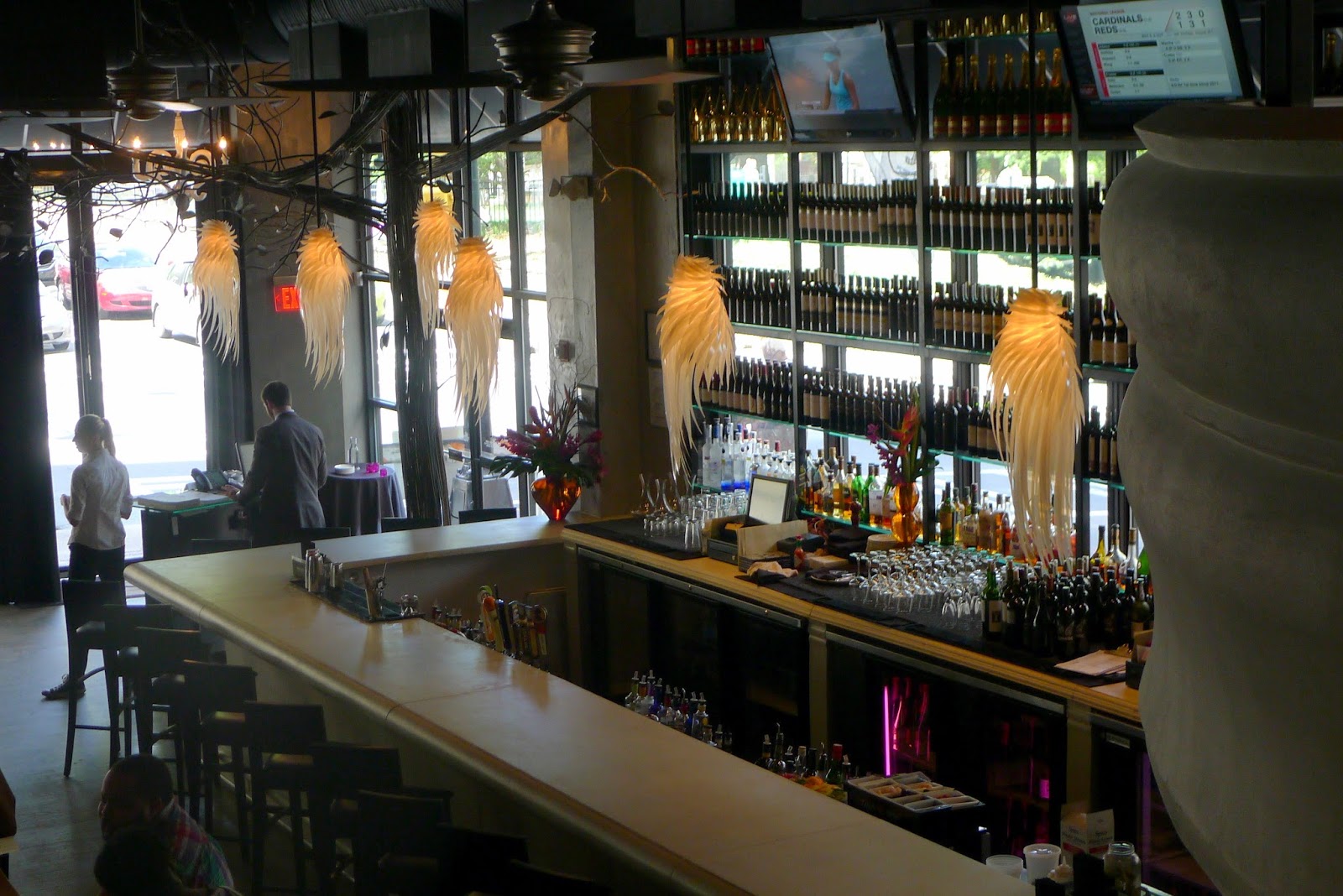
  Creative sparks were also flying up the street at 5 Church where the hostess Mercury Arteaga explained, “I love this restaurant; It’s more of a museum.”  The entire book Art of War was inscribed on the ceiling!  Sea-creature-inspired light fixtures, undulating sculptures and ironic murals gave the space a funky, lively vibe as a young crowd toasted brunch with mimosas and ate sunny-side egg pizzas.  Word on the street is that this restaurant is opening on Market Street in Charleston. Outside the windows teams of crazily speeding bicyclists were racing a course through cordoned off streets.  The big city buzz was electrifying.
            I’ll return to Charlotte again, perhaps for a girlfriends’ get-away, NASCAR, a Panthers or Hornets game, concerts or culture.  A few days in a big city of skyscrapers and vitality is like a Red Bull for the mind and Charlotte is only 3 ½ hours away. In a cab after a long night out that included Margaret Cho at the Comedy Zone followed by late night blues at the Double Door, we were happily satiated by our big-city experience. 
             
If You Go:
The Dunhill Hotel:  www.DunhillHotel.com
The Bechtler Museum of Modern Art:  www.bechtler.org
5 Church Restaurant:  www.5church.com


Wednesday, February 18, 2015

Misadventures in Paradise


            This was not the greeting I expected as my husband and I checked in at the Charleston airport for a long awaited trip to St. Lucia. “I’m not going to be able to issue your boarding passes because your passports expire in less than 90 days.” 
            “But we’re only going for a week.  We’ll still have more than two months remaining on them when we return,” I said.
            “Sorry.” 
            We insisted; we cajoled; we pleaded.  The plane left without us. 
            “I can’t imagine being more disappointed than I am right now,” I said as we sat in the cafĂ© fuming.  I’d spent months securing a writing gig at a luxurious hotel and arranging for complicated family responsibilities.  We had just finished 11 days of hosting over 20 family members during which the image of the St. Lucian hotel room, perched on a mountainside overlooking the ocean and twin peaks, had sustained me.  We had to fix it.  Even though it was barely 7 AM, we began making frantic phone calls:  trip insurance (no claim for this), the St. Lucia hotel, passport offices, the governor’s office (they’d help but it would take a few days) and American Airlines (they’d had our passport expiration dates since I’d booked the tickets months ago). 
The room we never saw. 

            This was not our first misadventure.   Twice we’d booked hotel rooms in far-flung places and bailed when we got there.  The remote beach and rocky shore in the Cayman Islands was unsuitable for our family with young children.  It only took one look at the garbage-strewn shore and dirty water in the Dominican Republic for us to rent a car and drive elsewhere. It had even happened closer to home at a chain hotel during the Savannah Jazz Festival.   The room reeked of cigarettes so we complained to the manager who said,  “If you think that room smells bad, you should come to my house.  It’s much worse.”  Uh, no thanks. 
            Mention misadventures and everyone has a story.  Two people told of missing trips abroad because their passports had too many stamps in them.  Not enough empty pages!  One of them was trying to leave on an expensive African safari he’d bought in a charity auction and lost thousands of dollars. 
            The worst misadventures involve the police.  We were stopped by two policemen in the Caribbean who showed us their radar gun indicating we’d been driving 2 miles over the speed limit.  It was a shake-down.  We gave them enough cash to buy themselves a nice lunch and drove off.  Our friend Jay wasn’t as lucky in New Orleans when a driver cut in front of him and his wife as they jogged across the street.  “What are you doing man?  You almost hit us!” he yelled as he swatted at the driver through an open window.  “I’m arresting you for assault, that’s what,” said the policeman in the unmarked car.  Instead of a weekend at the Jazz and Heritage Festival, he stewed in jail awaiting bail.
            Some misadventures require the police.  My widely travelled friends Steve and Laurie only found out afterwards that their cruise ship on the Nile had been fired upon by bandits from the shore while they slept. My friend Randy tells about taking a cab from La Guardia with an extremely agitated driver who continuously yelled into a cell phone while obsessively clawing with a back scratcher and repeatedly stopping in the middle of the expressway.  She dialed 911, poised to hit “send”.  Her son said later, “Sounds like a meth addict”.             
            Often misadventures end well.  My friend Ed recounts, “We took a red-eye and landed at Amsterdam’s Schiphol airport early in the morning. Our brains were half-asleep.  Before we got out of the airport, I went to a money-changing kiosk to cash in dollars for Euros to rent a lovely apartment in Anne Frank's neighborhood.” He exchanged $1300 and took a cab across town to pay the landlord but discovered that he only had the equivalent of $650. “I took a cab back to the airport, talked my way through security, and got to the kiosk. I told the lady that I was a total idiot, but that I had walked away without checking my money. ‘I never make mistakes,’ she said, ‘but I will count today's cash.’ In another minute, the supervisor appeared with $650 in Euros. I instantly fell in love with the Dutch people.”
At Copamarina Resort in Guanica, Puerto Rico
            Back in Charleston I was very discouraged.  “I have bathing suits and flip flops in my suitcase. We are not going home.  We’re going somewhere warm!  Today!”  I insisted.  On the phone with American Airlines my husband asked the essential question, “Where can we exchange these tickets to go today that’s warm and doesn’t require a passport?”  Within 24 hours we were wading in the Caribbean in Puerto Rico.  “We fixed it.”  I sighed.  It had paid to be flexible and proved once again that the difference between a trip and an adventure is when things don’t go as planned. 
           

Check document requirements and find help abroad here:  www.travel.state.gov


Friday, January 23, 2015

Boogie (Half-way) Down!


            What happened to my generation?  We joyfully danced in the mud at Woodstock and in the street with Martha and the Vandellas.  I hope we’re not getting stodgy and leaving all the fun for the younger music lovers.  There are plenty of chances within a half day’s drive of Charleston to jump back into the conga line.  Heck, we may even enjoy it more than we used to.  Age does have its advantages.  For example:   
  1. We don’t have to sleep on the ground, in the rain.  We’re totally comfortable insisting that comfort matters. At the Lake Eden Arts Festival in North Carolina you can make a pot of coffee and sip it on your bunkhouse porch as you listen to the music begin down the hillside.  At The Spirit of Suwannee Music Fest in Live Oak Florida you can even buy a park cabin to stay in. Or get really comfy at a B&B like Virginia’s Ambrosia Farms where breakfast comes right from the garden and Floydfest is just up the road.    
  2. Or we can sleep on the ground in the rain but not hassle with setting up. Strap your gear to a wagon and slide it onto the nifty trailer pulled by the shuttle buses at Floydfest.  They’ll dropyou right off at the campground ready to go.  Or drive your RV and make new friends.  Or check out any of the 8 Southeastern festivals where Dancin’ Dave’s Festival Camping “takes the rough out of roughing it” by setting up a first class campsite including everything from tents to portable showers. 
  3.  We can pay to play now. We may have been hippies or yippies or yuppies.    But now we can be VIP’s.  Ante up to sit on the stage, share a toast with the performers, get special parking, check in early and enjoy the swag of privilege.  Floydfest’s high rollers get benefits ranging from fully catered meals and bar to backstage massages.  At the Hangout Festival in Alabama, VIP’s can even enjoy the music from a stage-side hot tub.   We’re big shots now. We earned it.


4.  We invented “get your freak on”.  We embarrassed our children for decades and furthermore we’re old enough to not care what anyone thinks of us.  What’s in the back of your closet?  Tie-dye, gauze skirts, kilts and a belly-dance outfit? Glitter?  Feathers?  Why not?  Now post that photo on your Facebook page and tag your kids.
5.  It’s not just about the music.  There’s kayaking and fun runs, stand-up paddle boarding and bungee jumps, journaling and slam poetry, craft making and yoga. And that’s just what’s offered through many festivals.  Nearby there are fine restaurants, antique shopping, historic sights and wineries.  Explore, take a breather.  No one’s the boss of you.
6.  We've been there and done that so we know that the best moments at festivals are not always among the hordes. At the New Orleans Jazz and Heritage Festival where the crowds at the headliner stage are the size of our hometown populations, we escape.  A few steps away, in the smaller tents, transcendent musical moments await.  Or we pick a smaller festival to begin with, like MerleFest in Wilkesboro, N.C. We can see Bruce Springsteen better on TV anyhow.
7.  We have an app for that.  We may have learned from our kids but now we’re adept at downloading the schedules to our cellphones, using Youtube to plan the bands to catch and buying music online afterwards.  We help each other by sharing earplugs and giving advice  such as the wife in front of Floydfest’s main stage that was overheard telling her husband, “You might want to take out your hearing aid for this band honey, it looks like it will be a little loud”.
8.  “Be Here Now” is our generation’s motto.  We know where the off-switch is on our phones.  We don’t watch the world through a viewfinder.  We don’t need to tweet, text and tantalize our friends.  Hush; be still, we’re listening to the music.
9.  We have more fun when we’re not vomiting.  We were young too.  We have a repertoire of stories of stupid things we did while we were high or drunk.  But now we have the wisdom gained from experience.  We calibrate our intakes for maximum enjoyment.
10.  We’re like Buddy Guy.  Many of our musical heroes crashed and burned early, leaving only their nascent music behind.  Then there are the ones who we’ve grown older with. They’re the soundtrack of our lives. Our own dance party.  When Buddy Guy sings, “I’m 74 years young and I still know how to have my fun” we aren’t  too shy to shout “right on”.
If You Go:
Find a festival and go at http://www.festivalfinder.com/


Wednesday, August 20, 2014

Hanging Out with Henry Flagler

         On one of the ubiquitous ghost tours in this historic city, my fellow journalists are imagining that their photos reveal evidence of dead dogs lurking by woodstoves, phantasmal children wandering in the dark park.  I see Henry Flagler.  It’s not hard to imagine he’s still here in  St. Augustine since the entire city is full of his accomplishments.  Nothing stood in the way of his vision.  When he admired a building, he either bought it or imitated its architecture.  He built jails and churches so he could dictate their location.  In his grandiosity he built a Venetian Renaissance church in the memory of a deceased daughter, a magnificent hotel to honor his wife.  He also spawned a legacy of entrepreneurism that still fuels this city. 

     Flagler invited industrialists to enjoy St. Augustine’s warm climate, and built a railroad to get them there.  People like John D. Rockefeller, with whom Flagler started Standard Oil, broke bread with railroad tycoons, church and elected leaders.  I can imagine him hosting a lavish celebration today in the newly remodeled Treasury on the Plaza, an event space made from a 1928 bank.  The grandeur of the building is reminiscent of the Casa Monica Hotel and Flagler College architecture.  The host might tell the story of building the world’s largest swimming pool.  “I was worth $8 million when I got here.  I wanted a swimming pool.  But no one would use it because it smelled like sulfur. So I invited a bunch of Northern doctors down.  Gave them free vacations. Just swim everyday I said. Then everyone swam.”  The deep end of that same pool is now CafĂ© Alcazar.  Joseph Finnegan, the innkeeper at the St. Francis Inn is also a problem solver.  Opened in 1791, his bed and breakfast is the oldest continually used inn in America’s oldest city.  Its unique rooms, courtyard, swimming pool and dining room are charming and exceedingly well appointed. But it didn’t have a beach so the owners developed some property on the coast nearby and now guests can enjoy both when they stay at either:  breakfast or parking in town, beach chairs and towels at the beach.  
                    Flagler might go on to tell about his divorce from his second wife.  She was in a mental institution but divorcing her was illegal in Florida.  So he worked to change the law, much like that of another of Flagler’s likely guests Philip McDaniel who started St. Augustine Distillery.  He worked two years to change the  law that prohibited them from having their distillery, shop and Ice House Restaurant in proximity.  “There were a lot of hurdles but we were committed because of our love of the town.”  A true farm-to-table enterprise, they work with local farmers to preserve agricultural history by growing everything from sugar cane to heirloom corn and citrus for their emerging line of liquors.  One farmer, Mr. Arroyo, sums it up: “People get excited about vegetables but they get more excited about booze.”
          San Marcos is surrounded by walls made from coquina shells.  It’s never been conquered.   Captain Ryan explained “If you think of throwing an M&M into a jar of peanut butter, that’s how the cannonballs fired into the fort got stuck in the walls.”  The Spanish actually dug the cannonballs out, wrote hate notes on them and fired them back becoming the “first white people to recycle”. 
  Sharing Flagler’s love of the area’s natural beauty would be Captain Ben Evans and Zach McKenna of St. Augustine Eco Tours.  Their passion for protecting the environment is obvious in their excursions which combine nature and history.  They tell stories from the wake of shrimp boats as dolphins frolic.  The iconic Castillo de
            On the table would be delights from the city’s best chefs:  the deconstructed caprese salad from Chef Jean-Stephane Poinard of Bistro de Leon with its beautiful peeled love apple stuffed with mozzarella mousse, datil pepper sauces from Hot Shot bakery, pasta from Nona’s Trattoria, exotic olive oils from The Ancient Olive and desserts from French chocolatier  at Claude’s Chocolates.  The guests might plan a further exploration of the city’s culinary delights on The Tasting Tour where Flagler would feel right at home climbing into the horse and buggy to discover hidden dining gems.


            Flagler and his guests would proudly toast eachother’s accomplishments.  St. Augustine is now one of the country’s most popular wedding destinations, girl’s get-aways and one of the top 5 places in the world for Christmas lights according to National Geographic Magazine.  I imagine the party winding down, the guests ambling over cobblestone streets past their host’s magnificent namesake Flagler College, back to the St. Francis Inn.  They’d cap off the evening with one of Chef Janice Leary’s nightly treats, a bit of sherry and revel in the enduring virtues of St. Augustine. 
For More Information:
more photos are here:  St. Augustine photos

Tuesday, July 22, 2014

Unleashed in Athens Georgia


             “You’re nothing like your father.  Take off your clothes and jump in the water.” 
Thayer Sarrono’s teasing lyrics accompanied our welcome toast as we began our visit to Athens, Georgia.  My husband and I were ready for some adult fun.  The University of Georgia is often ranked among the country’s top party schools and the town’s motto is “Life Unleashed” so we were hopeful we’d find it here.     
            The Foundry Inn and Spa got the good times rolling right away.  This is the city that famously birthed some of the country’s best bands: R.E.M., Widespread Panic, the B-52’s and many others.  Just a few steps from our comfortable room at the hotel was the Melting Point.  Every city should have a venue like this one with a first-class sound system, a big stage and a room full of enthusiastic listeners of all ages.  There are outdoor seats for folks who want to smoke or talk more loudly, a bar with TV’s away from the stage and plenty of seats around the large dance floor as well as a balcony perched above.    As we listened to Thayer’s folky set we munched on fish tacos from the menu that ranges from snacks to hearty meals.   We really appreciated that the music starts quite early.  You can catch the headliners and still be in bed before midnight.  It was so fun and easy that we went every night. The club hosts plenty of stellar local talent as well as national acts like The Soul Rebels who rocked the house a couple of nights later with their explosive New Orleans brass sound.  We never left the dance floor and couldn’t believe our luck in seeing this world class band in such an intimate venue as they stopped in Athens on their world tour, next stop France.  And what a bargain!  Admission to the Melting Point was included in our hotel charge and is otherwise only about $10.  We’d return to Athens just to go to the Melting Point again.

            At Mama’s Boy CafĂ©, you can get two essentials:  a creative breakfast and life advice.  My colorful plate of vegetable hash with a poached egg and hollandaise sauce made me reach for my camera before I took a bite.  The menu invites diners to be true Southerners and order a biscuit sandwich with eggs or fried chicken or channel their inner child and go for the warm breakfast chocolate cake.  With our bellies full, we selected a thought for the day from their fishbowl on our way out. I’ve tried to take mine to heart:  “Good judgment comes from experience and experience—well, that comes from poor judgment”.  
            Hobnobbing with the friendly crowd at the Athens Wine Weekend, many people commented to us that Athens is not your typical college town.  “The wide range of ages, the cool and funky vibe and the burgeoning creative industry have contributed to a town of professionals that are very creative.  It makes you dream and to live beyond what you imagined when you came out of college” said Meredith Metcalf of the Classic Center which hosted some of the weekend’s events.  The Wine Weekend is a fundraiser each January for the Cultural Foundation which provides scholarships, buys art and makes grants to cultural organizations.  It began with a classy Amuse Bouche where
we sampled several wines including the Sea View Ridge Pinot Noir which was described as “not your Tuesday night wine.  This is the we-just-got-engaged wine”.  The next afternoon almost 1,000 people came to the wine tasting and a sold-out crowd enjoyed the Gourmet Dinner that evening where shrimp timbale was the first of six courses highlighting the city’s best chefs. 
            Meanwhile, we were exploring the town’s other attractions.  Since the Bulldogs weren’t playing football that weekend, nothing was very crowded.  At certain times of year, it’s all about those “Dawgs”.   We especially enjoyed the 313-acre State Botanical Garden where we wandered the hiking trails amid the frost-covered trees.  The town’s North Oconee Greenway drew my husband for a morning jog and I wandered the town’s pretty downtown where 16 neighborhoods are on the National Register and history is around every turn.  Stately columned houses, many with historic markers, abound. 
The University was the first state college in the country to be chartered in 1785 and the campus is particularly charming. Scattered amid the grand architecture are occasional funky sculptures made from found objects, many inspired by bulldogs of course.   It’s all part of Athens' Dawg-as-muse attitude to “loosen up your collar” and enjoy.   


If You Go:
  
Foundry Park Inn and Spa